 |


| Quantity: | |
|---|---|
2“-56”
J-VALVES
Forged Steel A105 Mounting Trunnion Ball Valve
The J-VALVES Forged Steel A105 Mounting Trunnion Ball Valve employ investment or shell cast bodies & tailpieces, all produced from ASTM grade materials that are properly heat treated and chemically finished. All wall thicknesses comply with ASME B16.34 as do bolting stress levels.
Industrial and Oil/Gas piping applications requiring the higher flow capacity and lower pressure drop of full port internal flow-ways, and those applications where ease of repairability is desired.
Forged Steel A105 Mounting Trunnion Ball Valve, constructed, and tested according to API and ASME/ANSI Standards. Other international standards including BS and DIN are also available upon request.
1.Forged steel A105 mounting trunnion ball valve Technical specifications:
3-Piece Bolted Body, Full Port Construction
Fully Compliant to ASME B16.34
Fully Compliant to API 6D
API 607 6th Edition Fire-Safe
Submerged Packing System & Direct Mount Actuation
Second Generation PTFE Seats Provide Higher Operating Temperatures
Standard Electrically Grounded Ball & Stem
2. Forged steel A105 mounting trunnion ball valve Product Specification:
Size: 1/2''-56''(DN15 ~ DN1400)
Pressure Rating: 150LB-2500LB(PN20 ~ PN420)
Material: A351 CF8M/CF8/CF3/CF3M, A216 WCB, A352 LCB/LCC,A105/F304/304L/F316/F51/F53/C3/F2/C95800
Suitable Temperature: -196ºC ~ 450ºC( Different temperature choose different materials).
Suitable Medium: Water, Steam, Oil and natural gas etc.
3.Forged steel A105 mounting trunnion ball valve Product Feature:
Fixed ball, full bore or reduce bore.
Mounting trunnion Ball valve
Blow-out proof stem design.
PTFE/RPTFE seat seal( Seat seal material could be decided by customer's request or according to valve's medium & temp. condition).
Anti-static design and API 607 Fire Safe Design available.
Operation: Hand wheel, Worm wheel,Gear, Pneumatic actuator & Electric Actuator.
4. Forged steel A105 mounting trunnion ball valve Product Drawing:
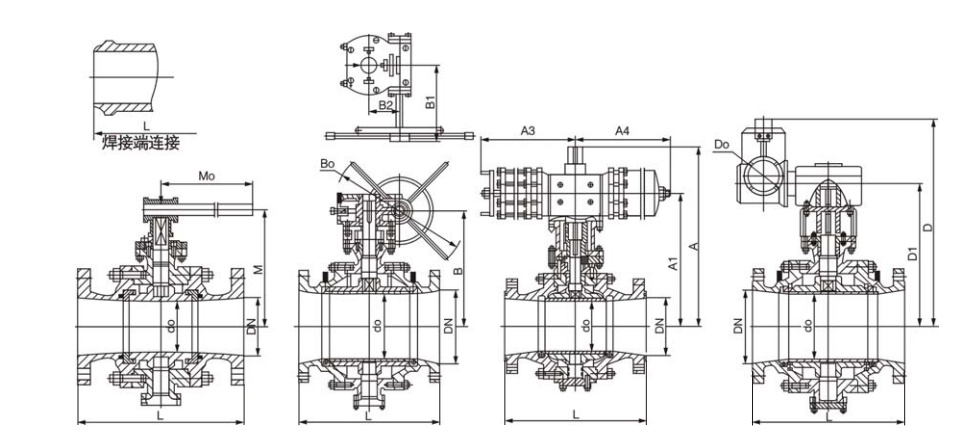
5. Forged steel A105 mounting trunnion ball valve Low Operating Torque:
The forged steel ball valve adopts the trunnion ball structure and floating valve seat, so as to achieve lower torque under operating pressure. It uses self-lubricating PTFE and sliding bearing to reduce the friction coefficient to the lowest in conjunction with the high intensity and high fineness stem.
6. Forged Steel Mounting Trunnion Ball Valve Emergency Sealing Device:
The API608 ball valve with the diameter more than or equal to 6″(DN150) are all designed with sealant injection device on stem and seat. When the seat ring or stem O ring is damaged due to accident, the corresponding sealant can be injected by the sealant injection device to avoid medium leakage on seat ring and stem. If necessary, the auxiliary sealing system can be used for washing and lubricating the seat to maintain its cleanliness.
Note: All the data should be confirmed with the approved drawings of manufacturer.
Tips:
We also manufacture other type valves, as butterfly valve, check valve, globe valve, Y strainer, sanitary butterfly valve, sanitary ball and so on.
Any item meets your interest, anything confused you, pls keep me posted, let's talk more.
J-VALVES Service:
On Samples Buyer bear the air fee, but this fee will be reduced from order directly
On After Sales Free replacement if there is any quality problem
On Delivery Never delay delivery time
On Materials Ensure material pure
Ensure material pure





