| Availability: | |
|---|---|
| Quantity: | |
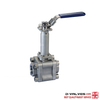
Cryogenic 2000psi Stainless Steel 3PC Full Bore Floating Thread Ball Valve
Product Features
Cryogenic Applicability: The design complies with BS6364 and GB/T 24925 standards and is suitable for working conditions with a working temperature as low as -196 °C.
Full Bore Design: The inner diameter of the passage is consistent with that of the pipeline, reducing fluid resistance and facilitating pipeline cleaning.
Floating Ball Structure: The ball can float freely under the action of fluid pressure, enhancing the sealing performance and reducing the operating torque.
Three-Piece Structure: It is convenient for installation and maintenance. The middle part can be easily disassembled, facilitating the replacement of seals and repairs.
Threaded Connection: It provides multiple threaded interfaces to meet the installation standards of different regions.
Fire Safety: It complies with the API 607 fire safety standard, ensuring safety under extreme conditions such as fires.
Anti-static Design: It is equipped with anti-static devices to prevent static electricity accumulation and improve safety.
ISO 5211 Mounting Platform: It supports the direct installation of actuators to achieve automated control.
Multiple Sealing Materials: The valve seat adopts high-performance sealing materials such as PTFE, which can maintain reliable sealing performance under low temperature conditions.
Technical Parameters
Size Range: 1/2" - 4" (DN6 ~ DN100)
Working Pressure: 1000WOG ~ 2000WOG
Working Temperature: -196 °C ~ 200 °C
Applicable Media: Liquefied natural gas, liquefied petroleum gas, air, nitrogen, oxygen, carbon dioxide, etc.
Connection Method: Threaded connection
Material:
Valve Body: Stainless steel 304, 316, 304L, 316L
Ball: Stainless steel 316
Valve Stem: Stainless steel 316, with anti-blowout design
Seals: PTFE, RPTFE
Operation Method: Manual operation. An ISO 5211 mounting platform can be optionally equipped for electric or pneumatic actuators.
Application Fields
Liquefied Natural Gas: It is used in LNG receiving stations, transport ships and regasification facilities.
Liquefied Petroleum Gas: It is used in LPG storage and transportation systems.
Air Separation: It is used for cryogenic fluid control in air separation units.
Chemical Industry: It is used for handling cryogenic chemical fluids.
Pharmaceutical Industry: It is used for the transportation and control of cryogenic media.
How to choose a forged or cast valve body: API 600 vs API 602 size limits, casting quality factor, NDT coverage, weld repair policy and cost crossovers.
How pressure seal bonnet valves work, why bolted bonnets stop at Class 900, seal ring materials, disassembly rules and the low-pressure leak signature.
A lift check valve closes in millimetres, not degrees. Disc lift, cracking pressure, chatter, and why steam and compressor duty punish a badly sized one.
Category A and Category B butterfly valves differ at the seat, not the body. What each one seals with, where each leaks, and what to put on the datasheet.
Butterfly vs gate valve compared by loss coefficient, pumping energy cost, weight, torque and leakage class, with selection rules and datasheet data.
How solid, flexible and split wedges differ in sealing, thermal binding and misalignment tolerance, plus selection rules and RFQ data.
The backseat, the gland and the blowout-proof stem decide whether a gate valve leaks at the stem, and whether it can be repacked with the line still live.
A fire-safe valve must still isolate after its soft seat has burned away. What API 607 and ISO 10497 test, and what the certificate does not cover.
How to size pneumatic valve actuators: valve torque, safety factors, spring-return vs double-acting, air pressure, stroking time and fail-safe position.
What the sleeve actually seals againstA sleeve type plug valve has three parts in the sealing path: a metal plug with a through port, a moulded sleeve of PTFE or PFA that wraps the plug and carries its own matching port, and a metal body liner behind the sleeve. Nothing is injected and nothing is gr
Bronze, 90/10 cupronickel, duplex, super duplex and Monel in seawater: what pits, what erodes, and how to write the material call-out.
Why check valves slam, what the Joukowsky surge really depends on, and how to select swing, dual plate and spring-loaded checks by flow deceleration.
Y-type, basket and duplex strainers sized by open area ratio: mesh openings in micron, clean and dirty pressure drop, and why baskets fail on steam.
Wafer, lug and double flanged butterfly valves compared: bolting, dead-end service, removal, gasket faces and where each body style fails.
Triple offset butterfly valves seal metal to metal with zero rubbing travel. Compare offsets, torque curves and seat materials for high temperature duty.
Learn about 5A gate valve material properties, pressure-retaining design, corrosion resistance and industrial applications. Explore J-VALVES solutions for demanding valve service requirements.
API 609 stops at NPS 60, AWWA C504 at 72 in. What really governs a DN2000 butterfly valve: offsets, shaft deflection, velocity and six failure chains.
Bellows seal globe valves fail at year two, not year ten. Three limits: cycle budget, fouled convolutions, load path. ISO 15848-1 classes included.
Discover how centerline wafer butterfly valves work, including disc design, seat sealing, flange installation and industrial applications. Explore J-VALVES valve solutions for water and general process systems.
Explore DBB reduced-bore ball valve design, sealing logic, oil and gas applications, and checks for materials, end connections, ratings, and test records.