| Availability: | |
|---|---|
| Quantity: | |
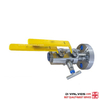
Dual Isolation Function: The valve is internally designed with two independent sealing balls, enabling dual isolation to ensure no medium leakage during maintenance or overhaul.
Bleed Function: Equipped with one bleed port, which can safely discharge residual media in the pipeline after isolation, preventing media accumulation and pressure buildup.
Floating Ball Design: The ball can float freely under the pressure of the medium, fitting tightly with the valve seat to form an excellent sealing effect, and also has an automatic pressure relief function.
Fire Safety Design: Complies with API 607 standards. Even in case of fire, the valve can still maintain sealing performance to prevent safety accidents caused by medium leakage.
Anti-Static Device: Built-in anti-static device effectively prevents static accumulation, reducing the risk of fire and explosion.
Multiple Connection Methods: Offers threaded connection (NPT) and flange connection (RF), conforming to ASME B16.5 standard, ensuring installation reliability and compatibility.
Compact Design: Three-piece structure reduces installation space and weight, while lowering installation costs.
Size Range: 1/2″ to 12″ (DN15 to DN300)
Pressure Range: ANSI Class 150 to Class 2500 (PN16 to PN420)
Temperature Range: -46℃ to +240℃
Material Options:
Valve body: A105, A182 F304 (L), A182 F316 (L), A182 F51, etc.
Ball: A105, A182 F304 (L), A182 F316 (L), A182 F51, etc.
Valve seat: PTFE, PEEK, NYLON, PPL, etc.
Connection Methods: Threaded connection (NPT), flange connection (RF)
Operation Modes: Various actuators available, including manual, electric, and pneumatic
Design Standards: API 6D, ASME B16.34, DIN 3357, GB/T 12237
Testing Standards: API 598, EN 12266
Oil and Gas Industry: Used in exploration, gathering, processing, and transportation systems of oil and gas fields to realize isolation, control, and discharge of oil and gas.
Chemical Industry: Suitable for transportation and reaction systems of various chemical media, preventing medium leakage and ensuring production safety.
Pharmaceutical Industry: Applied in pipeline systems during pharmaceutical production to ensure medium isolation and cleanliness in the drug manufacturing process.
Food and Beverage Industry: Meets food-grade requirements, used in pipeline systems for food and beverage production to ensure hygiene and safety.
Urban Gas Industry: Used in pressure regulating stations, gas storage stations, and gas transmission pipelines of urban gas networks to ensure safe supply and stable transportation of gas.
High Reliability: Dual isolation and bleed functions ensure stable operation of the valve under various working conditions, reducing maintenance frequency and downtime.
High Safety: Fire-resistant and anti-static design, along with low-leakage emission characteristics, effectively reduce safety risks such as fire, explosion, and leakage.
Easy Installation and Maintenance: Multiple connection methods simplify the installation process, and the compact structure of the valve facilitates maintenance and overhaul.
Wide Application Range: Multiple material options and a wide range of pressure and temperature ranges enable it to adapt to various complex working conditions and medium characteristics.
Dual Isolation Function: The valve is internally designed with two independent sealing balls, enabling dual isolation to ensure no medium leakage during maintenance or overhaul.
Bleed Function: Equipped with one bleed port, which can safely discharge residual media in the pipeline after isolation, preventing media accumulation and pressure buildup.
Floating Ball Design: The ball can float freely under the pressure of the medium, fitting tightly with the valve seat to form an excellent sealing effect, and also has an automatic pressure relief function.
Fire Safety Design: Complies with API 607 standards. Even in case of fire, the valve can still maintain sealing performance to prevent safety accidents caused by medium leakage.
Anti-Static Device: Built-in anti-static device effectively prevents static accumulation, reducing the risk of fire and explosion.
Multiple Connection Methods: Offers threaded connection (NPT) and flange connection (RF), conforming to ASME B16.5 standard, ensuring installation reliability and compatibility.
Compact Design: Three-piece structure reduces installation space and weight, while lowering installation costs.
Size Range: 1/2″ to 12″ (DN15 to DN300)
Pressure Range: ANSI Class 150 to Class 2500 (PN16 to PN420)
Temperature Range: -46℃ to +240℃
Material Options:
Valve body: A105, A182 F304 (L), A182 F316 (L), A182 F51, etc.
Ball: A105, A182 F304 (L), A182 F316 (L), A182 F51, etc.
Valve seat: PTFE, PEEK, NYLON, PPL, etc.
Connection Methods: Threaded connection (NPT), flange connection (RF)
Operation Modes: Various actuators available, including manual, electric, and pneumatic
Design Standards: API 6D, ASME B16.34, DIN 3357, GB/T 12237
Testing Standards: API 598, EN 12266
Oil and Gas Industry: Used in exploration, gathering, processing, and transportation systems of oil and gas fields to realize isolation, control, and discharge of oil and gas.
Chemical Industry: Suitable for transportation and reaction systems of various chemical media, preventing medium leakage and ensuring production safety.
Pharmaceutical Industry: Applied in pipeline systems during pharmaceutical production to ensure medium isolation and cleanliness in the drug manufacturing process.
Food and Beverage Industry: Meets food-grade requirements, used in pipeline systems for food and beverage production to ensure hygiene and safety.
Urban Gas Industry: Used in pressure regulating stations, gas storage stations, and gas transmission pipelines of urban gas networks to ensure safe supply and stable transportation of gas.
High Reliability: Dual isolation and bleed functions ensure stable operation of the valve under various working conditions, reducing maintenance frequency and downtime.
High Safety: Fire-resistant and anti-static design, along with low-leakage emission characteristics, effectively reduce safety risks such as fire, explosion, and leakage.
Easy Installation and Maintenance: Multiple connection methods simplify the installation process, and the compact structure of the valve facilitates maintenance and overhaul.
Wide Application Range: Multiple material options and a wide range of pressure and temperature ranges enable it to adapt to various complex working conditions and medium characteristics.
In the application of Trunnion ball valve, the DBB (Double Block and Bleed) seat design is a common choice. Its unique structure gives it significant advantages under specific working conditions. The following are the appropriate times to choose the DBB seat design and related considerations.Applica
Corrosion Resistance: A Reliable Guarantee for Harsh EnvironmentsThe corrosion resistance of the C95800 bronze filter is one of its core advantages. In fields such as ocean engineering, shipbuilding, and chemical equipment, equipment often needs to be exposed to corrosive environments such as seawat
In industrial applications, particularly in high-temperature sulfur corrosion environments, the durability and reliability of filtration systems are crucial. S32760 super duplex stainless steel Y-type strainers are widely used due to their excellent mechanical properties and corrosion resistance. Ho
In the field of industrial fluid control, the selection of valves is crucial to the efficiency, safety, and maintenance costs of a system. J-VALVES nickel-aluminum bronze floating ball valves are widely recognized for their exceptional performance and reliability.1. Corrosion ResistanceNickel-alumin
<br /> In industrial fluid systems, check valves and butterfly valves are two common types of valves, each with its own unique functions and application scenarios. Selecting the appropriate valves is crucial for ensuring the safe and efficient operation of the system.
Understanding Y-Type StrainersStructure and FunctionY-type strainers consist of a cylindrical body, a Y-shaped strainer basket, and connections for inlet and outlet pipes. The strainer basket, typically made of perforated metal or mesh, allows fluid to pass through while trapping solid particles. Th
DBB ball valves play a crucial role in industrial pipeline systems. With its unique double block and bleed design, it can ensure that when the valve is closed, the medium in the pipeline is effectively blocked, and at the same time, the residual medium in the valve chamber can be discharged, greatly
High voltage design and excellent sealing performanceStainless steel high-pressure ball valves are specifically designed for high-pressure environments and can withstand extremely high pressures while maintaining excellent sealing performance. Its sealing surface adopts an advanced hardened surfacin
In the petrochemical industry, as a key component in pipeline systems, the selection of y-type strainers is of crucial importance. Choosing the appropriate materials can not only ensure the performance and service life of the strainers but also maximize the cost-benefit in the long-term operation.
During the process of a certain large-scale ship manufacturing and renovation project, there was an urgent need to find a valve that could adapt to the complex marine environment and meet the diverse needs of the ship's efficient operation. At that time, the C95800 triple eccentric lug butterfly valve under J-VALVES stood out with its outstanding comprehensive performance and won the bid successfully in the project tender.
After a month's production cycle, 12 sets of 12-inch swing check valves have been completed normally and delivered to customers.
Over the past decade, industrial-grade stainless steel DBB (Double Block & Bleed) ball valves have gradually evolved from a "high-end optional component" to an indispensable key safety element in systems such as oil and gas, chemical engineering, refining, offshore engineering, hydrogen energy, and high-purity medium transportation. As global factories continue to raise requirements for safety levels, emission standards, and automation capabilities, DBB ball valves are accelerating the replacement of traditional dual-valve structures and have become one of the product categories with the greatest growth potential in future industrial fluid systems.
What is the most troublesome issue for engineers in applications such as oil refining, natural gas transportation, steam systems, metallurgy, and power plants?<br /> ——It lies in high temperature, high pressure, frequent opening and closing, strict sealing requirements, and the risk of system shutdown or safety hazards once leakage occurs.
In modern industrial pipeline systems, ensuring the safe, stable, and continuous operation of equipment is a top priority for every engineer. However, whether in petrochemical plants, natural gas transmission and distribution networks, boiler steam systems, or large-scale cooling water circulation networks, the presence of fluid flow inevitably leads to solid contaminants such as particles, impurities, rust, and welding slag.
In every industrial site, there are "silent yet crucial" roles. They lack a striking appearance and do not make loud noises, yet they take on irreplaceable responsibilities under the most dangerous and harsh operating conditions.
Against the backdrop of accelerated integration of the global energy and industrial equipment supply chain, DBB (Double Block and Bleed) ball valves that can simultaneously meet the European CE certification and North American API 6D standard have become a critical choice for oil, natural gas, chemical, LNG, and high-integrity pipeline systems.
In the global energy industry, LNG (Liquefied Natural Gas) liquefaction projects have nearly harsh requirements for the ultra-low temperature resistance, sealing reliability, and structural strength of valve equipment. As one of the world’s largest LNG exporters, a certain country launched an expansion project for a large-scale LNG liquefaction plant.
Addressing these industry pain points, J-VALVES leverages its industrial valve manufacturing experience since 2009 to launch the Stainless Steel 600LB / 304 T-Strainer. With high strength, high reliability, and customization capabilities, this product solves the key concerns of enterprises in real-world operating conditions.
Since 2009, J-VALVES has been deeply engaged in the field of industrial valves and filtration products. Among its offerings, this 150LB WPB flanged basket filter, with its robust structural design, excellent filtration performance, and reliable, durable materials, is widely used in industries such as petrochemicals, natural gas, shipping, water supply, and power plants. It is regarded as a professional-grade filtration solution for long-term stable operating conditions.
Understanding Your Application RequirementsBefore selecting a gate valve, it is essential to understand the specific requirements of your industrial application. This includes:• Fluid Type: Determine the type of fluid that will flow through the valve. Common fluids include water, oil, steam, gases,