| Size: | |
|---|---|
| Availability: | |
| Quantity: | |
Butterfly Valve
J-VALVES
Main Features
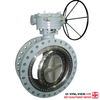
Triple eccentric design: Through axial, radial, and angular eccentric designs, the contact between the disc and the valve seat is completely separated during the opening and closing process, significantly reducing friction and extending the service life of the sealing surface.
Metal sealing: Adopts a metal-to-metal sealing structure, providing excellent sealing performance and achieving zero leakage even under high-temperature and high-pressure conditions.
Flange connection: Uses RF (Raised Face) connection, compliant with ANSI B16.5 standards, ensuring the reliability and tightness of the connection.
Fire-safe design: Complies with API 607 fire safety standards, ensuring sealing performance is maintained in extreme situations such as fires.
Anti-static design: Prevents electrostatic accumulation caused by medium flow, improving safety.
Multiple operation methods: Can be equipped with manual, gear-operated, or electric actuators to meet different operational needs.
Compact design: Features a compact structure and light weight, saving installation space and facilitating transportation and maintenance.
Technical Specifications
Nominal diameter: DN50 to DN1500 (2 inches to 60 inches)
Pressure class: 150LB ~ 900LB
Applicable media: Steam, water, oil, natural gas, corrosive media, etc.
Applicable temperature: -29℃ to 150℃
Valve body material: Cast steel (WCB)
Sealing material: Stainless steel, graphite, etc.
Connection method: Flange connection, compliant with ASME B16.5 standards
Design and manufacturing standards: API 609, ASME B16.34
Testing standards: API 598, EN 12266-1
Fire safety standard: API 607
Application Fields
Oil and gas industry: Used in oil and gas transmission pipelines, natural gas processing plants, oil refineries, etc.
Chemical industry: Suitable for chemical reaction systems, acid-alkali transmission pipelines, etc.
Power industry: Applied in cooling water systems and steam systems of power plants, etc.
Water treatment industry: Used in seawater desalination, municipal water supply systems, etc.
Food and beverage industry: Utilized in food processing, beverage production, etc.
Advantages
High reliability: Undergoes strict quality inspection and factory testing to ensure the performance and reliability of each valve.
Easy maintenance: Reasonable design facilitates disassembly and maintenance; there is no need to disassemble the entire pipeline system when replacing seals or repairing internal components.
High safety performance: Fire-safe and anti-static designs.
Wide applicability: Suitable for various media and working conditions, meeting the needs of different industries.
Automated control: Can be equipped with electric or pneumatic actuators to realize automated control.
Why LNG ball valve seats that pass warm tests leak cold at -162°C: contraction arithmetic, cold preload, PCTFE vs PTFE, ISO 28921-2 and MSS SP-134 limits.
What API 607 proves: burn sequence, 7th-edition leak limits per NPS, cavity pressure rules, API 6FA vs ISO 10497, and the clauses buyers must check.
MSS SP-80 bronze valves: the class number is a saturated steam rating, not a pressure rating. Alloys, threads, lead-free rules and where bronze stops.
Stellite or tungsten carbide for erosive service: erosion angles, hardness ratios, HVOF vs weld overlay, the 500 C limit, and the clauses that win acceptance.
Valve coating is a defect-budget decision, not a product choice: ENP vs FBE vs sprayed aluminium, holiday arithmetic, CUI and the specs that win acceptance.
Temporary and start-up strainers for commissioning: placement, plate versus mesh, blowdown discipline and the removal record that proves it was pulled.
What MSS SP-25 marking really commits to: body symbols, three-symbol trim marking, melt identification and the certificate that closes the loop.
Why ball valves pass high-pressure seat tests and fail at 0.6 MPa: seat preload arithmetic, SPE and DPE seats, DBB vs DIB-1/DIB-2, and test-proofing specs.
RF, RTJ and butt-weld valve ends compared: how each joint seals, which duty suits it, and the four assembly errors that cause most joint leaks.
Why PTFE and PFA liners fail when the chemistry is right: permeation arithmetic, vacuum collapse, cold flow and the 11:1 expansion mismatch at the flange.
C95800 and C95500 are cast to ASTM B148; C63200 is wrought to ASTM B150. Aluminum and manganese levels decide strength, weldability and valve use.
Jacket heat load arithmetic, sulfur's 159 C viscosity trap, the separate jacket pressure test and the weld failures buyers discover in year five.
API 603 and API 600 both cover bolted bonnet gate valves, but wall thickness basis, class ceiling and casting rules decide which one you can actually buy.
ISO 5208 Rates A-G explained with real numbers, how API 598, API 6D and FCI 70-2 map across, and what metal seats can honestly achieve.
How to choose a forged or cast valve body: API 600 vs API 602 size limits, casting quality factor, NDT coverage, weld repair policy and cost crossovers.
How pressure seal bonnet valves work, why bolted bonnets stop at Class 900, seal ring materials, disassembly rules and the low-pressure leak signature.
A lift check valve closes in millimetres, not degrees. Disc lift, cracking pressure, chatter, and why steam and compressor duty punish a badly sized one.
Category A and Category B butterfly valves differ at the seat, not the body. What each one seals with, where each leaks, and what to put on the datasheet.
Butterfly vs gate valve compared by loss coefficient, pumping energy cost, weight, torque and leakage class, with selection rules and datasheet data.
How solid, flexible and split wedges differ in sealing, thermal binding and misalignment tolerance, plus selection rules and RFQ data.

