Marine piping systems operate in some of the most challenging environments, where seawater corrosion, suspended particles, and continuous operation can significantly affect equipment reliability. Effective filtration is essential to protect pumps, valves, heat exchangers, and other critical components from damage caused by foreign particles.
Read More
In industrial pipeline systems, maintaining stable flow quality and protecting downstream equipment are essential for operational efficiency. Basket strainers play a critical role in removing solid contaminants such as rust, scale, welding debris, and particulate matter from fluid systems.
Read More
Strainers are essential components in industrial piping systems, protecting pumps, valves, meters, and other critical equipment from debris and contaminants. Among the most commonly used filtration devices are Y-strainers and basket strainers. While both serve the same basic purpose, their internal flow distribution characteristics differ significantly, directly affecting pressure drop, filtration efficiency, and maintenance requirements.
Read More
Marine piping systems operate in some of the harshest industrial environments. Continuous exposure to seawater, salt spray, moisture, and high-flow conditions creates serious challenges for filtration equipment. Among various material options, Nickel Aluminum Bronze (NAB) basket strainers have become a preferred solution for marine and offshore applications due to their outstanding corrosion resistance, mechanical strength, and long service life.
Read More
Marine piping systems operate in some of the most challenging environments, where seawater corrosion, suspended particles, and continuous operation can significantly affect equipment reliability. Effective filtration is essential to protect pumps, valves, heat exchangers, and other critical components from damage caused by foreign particles.
In industrial pipeline systems, maintaining stable flow quality and protecting downstream equipment are essential for operational efficiency. Basket strainers play a critical role in removing solid contaminants such as rust, scale, welding debris, and particulate matter from fluid systems.
Strainers are essential components in industrial piping systems, protecting pumps, valves, meters, and other critical equipment from debris and contaminants. Among the most commonly used filtration devices are Y-strainers and basket strainers. While both serve the same basic purpose, their internal flow distribution characteristics differ significantly, directly affecting pressure drop, filtration efficiency, and maintenance requirements.
Marine piping systems operate in some of the harshest industrial environments. Continuous exposure to seawater, salt spray, moisture, and high-flow conditions creates serious challenges for filtration equipment. Among various material options, Nickel Aluminum Bronze (NAB) basket strainers have become a preferred solution for marine and offshore applications due to their outstanding corrosion resistance, mechanical strength, and long service life.

Basket strainers are a fundamental component in industrial fluid systems, serving to protect pumps, valves, heat exchangers, and other downstream equipment from debris and particulate matter. Their design allows for efficient filtration, minimal pressure drop, and easy maintenance, making them ideal for a wide range of industrial applications. Understanding their structural design and operational principles is essential for engineers and plant operators aiming to optimize system performance.

Strainers are essential components in industrial piping systems, designed to protect pumps, valves, and downstream equipment from debris and particulate contamination. Among the most commonly used strainers are Y-strainers and basket strainers. While both perform filtration, their structural design, flow characteristics, maintenance requirements, and operational advantages differ significantly. Understanding these differences is crucial for engineers to select the optimal strainer for specific applications.

Strainers play a critical role in oil systems by removing debris, protecting pumps and valves, and maintaining smooth fluid flow. Among the most common types are Y-strainers and basket strainers. While both provide filtration, their energy efficiency, flow characteristics, and maintenance requirements differ significantly. Selecting the right strainer can improve system performance, reduce energy consumption, and lower operational costs.

In industrial and commercial fluid systems, strainers play a crucial role in protecting equipment, ensuring smooth operation, and preventing damage caused by debris, particles, or contaminants. Among the most commonly used types are Y-type strainers and T-strainers (also called basket strainers). While both perform filtration, their structural designs, applications, and operational characteristics differ significantly. Understanding these differences is key to selecting the right strainer for your system.

In industrial fluid systems, protecting pumps, valves, and other equipment from debris and particulate matter is essential for maintaining system efficiency and preventing costly downtime. Two of the most common filtration devices are Y-strainers and basket strainers. Both serve the same fundamental

In the world of industrial processing, pipeline integrity is paramount. Any contamination within pipelines can result in costly damage to machinery, reduced efficiency, and potential downtime. This is where Basket and Y-type strainers come into play, serving as critical filtration devices for a vari

Understanding Y-Type and Basket StrainersY-Type StrainersY-type strainers are named for their Y-shaped design, which includes a cylindrical body and a strainer basket. They are typically used for coarse filtration to remove larger particles from fluid streams.Structure and Function: The strainer bas

Understanding Filter Pressure DropDefinition and ImpactFilter pressure drop refers to the difference in pressure between the inlet and outlet of a filter. This pressure drop is a result of the resistance the filter medium offers to fluid flow. Higher pressure drop means more energy is required to pu

In modern industrial pipeline systems, the purity of liquid media is directly related to the operating efficiency and service life of equipment. J-VALVES Red Basket Strainer, featuring excellent structural design and high-quality material manufacturing, has become an ideal choice for numerous enterprises in the field of liquid filtration.
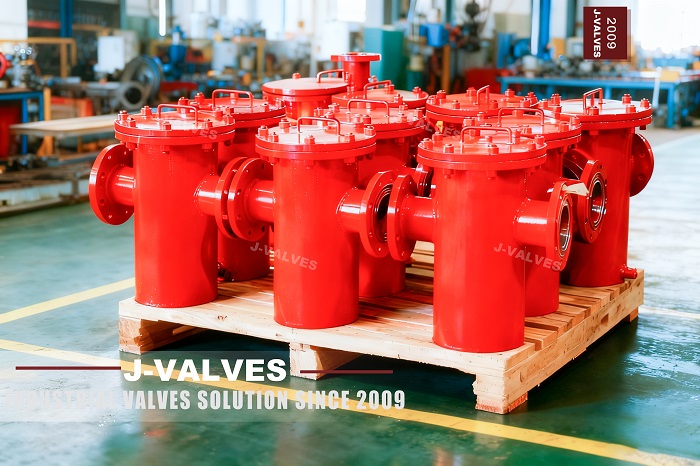
Since J-VALVES has been deeply involved in the valve field since 2009, the red basket strainer it launched, with its innovative self-cleaning diversion structure, has become a technical benchmark in industrial filtration scenarios, building a reliable defense for the clean transportation of fluid media.

I. Overview of Basket strainers and C83600 Bronze strainer ScreensBasket strainers are a common type of filtration equipment. They feature a simple structure, are easy to operate, have a large filtration area, and cause low pressure loss. They are widely used in industries such as chemical engineeri