| Availability: | |
|---|---|
| Quantity: | |
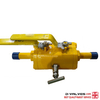
Dual-Ball Design: Adopts two balls and two valve seats to achieve dual isolation function. Even if one sealing surface fails, the other can still maintain sealing, ensuring no medium leakage.
Floating Ball Structure: The ball can float freely under the pressure of the medium, fitting tightly with the valve seat to form an excellent sealing effect. It also has an automatic pressure relief function: when the pressure in the valve cavity is too high, pressure can be automatically relieved through the valve seat to prevent valve body rupture.
Butt-Welded Connection: The valve body is connected to the pipeline via butt welding. This connection method features high strength and good sealing performance, capable of withstanding high pressure and temperature, suitable for various harsh working environments, and facilitating pipeline installation and maintenance.
Fire and Anti-Static Design: In case of fire, even if the sealing ring is burned, the metal components of the ball valve can still form a metal-to-metal hard sealing structure to prevent medium leakage and fire spread. Meanwhile, the conductive device inside the ball valve can conduct static electricity into the ground, avoiding safety accidents caused by static electricity.
Multiple Sealing Forms: Offers both soft sealing and hard sealing options. Soft sealing uses high-performance polymer materials such as PTFE and PEEK, with excellent sealing performance and corrosion resistance; hard sealing adopts a metal-to-metal sealing method, suitable for high-temperature, high-pressure, and high-wear working conditions.
Emergency Greasing Function: Greasing ports are provided at the valve seat and stem. When the sealing surface is damaged, sealing grease can be injected through the greasing device to achieve emergency sealing, extend the service life of the valve, and ensure the normal operation of the system.
Size Range: 1/4"~8"(DN6~DN200)
Pressure Range: 150LB~1500LB (PN20~PN260), capable of withstanding high-pressure working conditions to meet the pressure requirements of different pipeline systems.
Temperature Range: -50℃ to 200℃, suitable for the transportation of low-temperature and high-temperature media.
Material Selection:
Valve body material: A105, A350 LF2, A182 F304/F316/F316L/F317/F321/F51/F53/F55, etc. Suitable materials can be selected according to different working conditions and medium characteristics.
Ball and stem material: ASTM A182 F6A/17-4PH/XM-19/A182 F51/A182 F53/A182 F55, etc., with high strength and good corrosion resistance.
Valve seat material: RPTFE, DEVLON, PEEK, VITON, metal-to-metal, etc., meeting the sealing requirements of different media.
Actuators: Can be equipped with manual levers, gearboxes, pneumatic or electric actuators, with position indicators and locking devices for easy operation and control.
Testing Standards: Strict hydrostatic and pneumatic tests are conducted in accordance with international standards such as API 6D, ASME B16.34, and ISO 5208 to ensure the quality and performance of the valve.
Oil and Gas Industry: Used in pipeline systems during the exploration, gathering, processing, and transportation of oil and gas fields, such as natural gas pipelines and crude oil pipelines, to realize isolation, control, and metering of oil and gas.
Chemical Industry: Suitable for the transportation and reaction systems of various chemical media, such as pipelines for corrosive media like acids, alkalis, and salts, preventing medium leakage and ensuring production safety.
Petrochemical Industry: In production facilities of petrochemical enterprises such as refineries and ethylene plants, it is used to control and isolate various high-temperature, high-pressure, flammable, and explosive petrochemical products, such as gasoline, diesel, and liquefied gas.
Urban Gas Industry: Used in pressure regulating stations, gas storage stations, and gas transmission pipelines of urban gas networks to ensure the safe supply and stable transportation of gas.
Other Industrial Fields: Such as power, metallurgy, papermaking, etc., used for the transportation and control of various fluid media to meet the needs of different industrial productions.
Dust, oil mist, rust, and moisture in compressed air can damage pneumatic equipment, cause valve sticking, and create unstable pressure. Learn how a high-pressure Y-type filter improves air purification and system reliability.
Check valves, also known as non-return valves, are essential components in hydraulic and pneumatic systems. These valves ensure that fluid or air flows in only one direction, preventing backflow that could otherwise cause damage or inefficiencies. By maintaining the proper direction of flow, check v
Butterfly valves are a type of flow control valve commonly used across various industries, renowned for their compact design, cost-effectiveness, and ease of operation. These valves are particularly well-suited for applications involving large volumes of fluid, where precise control of flow is requi
In industrial systems where frequent on/off operation is required, plug valves stand out as an ideal choice. Known for their simplicity, reliability, and durability, plug valves are widely used across various industries, including oil & gas, water treatment, chemical processing, and more. Their abil
Y-strainer filters are critical components in the protection of pipelines and piping systems, preventing debris and particulate from damaging sensitive equipment downstream. Commonly used in industries such as oil & gas, petrochemical, water treatment, and food processing, Y-strainers serve as the f
Learn how to match a 5A material 300LB gate valve with GB and ASME pipelines. This guide explains pressure class, flange standards, dimensions, media compatibility, and selection tips to reduce rework and improve project efficiency.
Large-diameter gate valves are critical components in various industrial applications, offering robust solutions for controlling fluid flow in high-pressure systems. These valves are primarily used in scenarios where efficient isolation or regulation of large quantities of liquids or gases is necess
In various industrial systems, contaminants present in fluids or gases can lead to significant operational disruptions, equipment damage, and system failure. Filters play a crucial role in preventing these contaminants from entering and compromising system integrity. From pipelines to machinery, fil
Gate valves, with their simple yet highly effective design, are crucial components in fluid control systems across various industries. Known for their ability to completely shut off the flow of fluids, these valves are widely used in applications where a straight-line, unobstructed flow is necessary
Nickel-aluminum bronze check valves, often referred to as dual-plate wafer check valves, are an essential component in many industrial applications. Known for their durability, corrosion resistance, and superior performance in harsh environments, these valves are frequently used in systems involving
How can engineering procurement reduce check valve corrosion risks? Learn how WCB check valves perform in corrosion resistance, where they fit best, and how they help projects lower maintenance costs and improve efficiency.
Why is leakage such a serious issue in oil and gas transport systems? Learn how bronze check valves help improve sealing reliability, corrosion resistance, and overall pipeline safety in demanding oil and gas applications.
In many industrial applications, controlling the flow of liquids and gases under high pressure is a crucial task. For such demanding environments, large-diameter gate valves are a key component in ensuring the safe and efficient operation of fluid control systems. These valves are particularly vital
In heavy industrial fluid systems, the performance and longevity of valves are critical to ensuring smooth operation and minimizing maintenance downtime. Among the various types of valves used in these systems, Nickel-Aluminum Bronze (NAB) butterfly valves stand out due to their exceptional strength
In industrial processes, closed-loop systems are widely used to ensure continuous operation, reduce waste, and improve energy efficiency. These systems rely on a loop of fluid or gas, circulating through components and returning to the system for reuse. To maintain optimal performance and prevent co
In hydraulic systems, precise control of pressure is crucial for maintaining system stability, efficiency, and safety. Among the many types of valves used in these systems, globe valves play an essential role in managing pressure, regulating flow, and ensuring optimal performance. What is a Globe Va
Why do standard butterfly valves often leak in demanding service? Learn how triple offset flanged butterfly valves improve sealing performance, reduce wear, and support high-temperature, high-pressure industrial applications.
Are corrosive fluids shortening valve life? Discover why carbon steel valves fail early and how stainless steel high-pressure ball valves deliver stronger corrosion resistance, better sealing, and longer service life in chemical, offshore, and high-pressure applications.
In the realm of industrial fluid control, selecting the right valve is essential to ensure optimal system performance, minimize downtime, and increase operational efficiency. Two commonly used valve types are ball valves and plug valves. Both types serve similar functions in regulating the flow of l
In many industrial applications, particularly those exposed to harsh environments or corrosive fluids, the selection of appropriate valve materials is crucial for maintaining system integrity and performance. One such material that stands out for its excellent corrosion resistance and durability is