|


| Quantity: | |
|---|---|
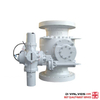
Three-Piece Design: The valve body is divided into three parts, allowing easy disassembly and maintenance, thus reducing downtime.
Forged Steel Material: The valve body is made of forged steel, featuring high strength and corrosion resistance, suitable for high-pressure and high-temperature environments.
Metal Sealing: Utilizes metal-to-metal sealing technology to ensure sealing performance under high-pressure and high-temperature conditions.
Electric Actuator: Equipped with a high-performance electric actuator to realize remote control and automated operation.
Compact Design: Small in size and light in weight, facilitating installation and integration into existing systems.
Fire Safety Design: Complies with API 607 standards, ensuring the valve maintains sealing performance even in case of fire.
Anti-Static Device: Built-in anti-static device effectively prevents static accumulation, reducing the risk of fire and explosion.
Blowout Prevention Design: The valve stem adopts a blowout prevention design to ensure operational safety.
Dual Piston Effect: The metal-sealed valve seat features a dual piston effect design, ensuring good sealing performance under low differential pressure.
Size Range: 2″ to 40″ (DN50 to DN1000)
Pressure Class: 150LB to 2500LB (PN20 to PN420)
Temperature Range: -46℃ to +500℃
Materials:
Valve Body: A105, A182 F304, F316, F304L, F316L
Ball: A182 F304, F316, F304L, F316L
Stem: A182 F304, F316
Sealing Material: Metal-to-metal (Stainless Steel, Inconel, etc.)
Connection Method: Flange connection (RF)
Operation Mode: Electric actuator
Design Standards: API 6D, ASME B16.34
Testing Standards: API 598
Face-to-Face Dimensions: Compliant with ASME B16.10 standards
Oil and Gas Industry: Used in exploration, gathering, and processing systems of oil and gas fields to ensure reliable isolation and control of media.
Chemical Industry: Suitable for transportation and reaction systems of various chemical media, preventing medium leakage and ensuring production safety.
Pharmaceutical Industry: Applied in pipeline systems during pharmaceutical production to ensure medium isolation and cleanliness in the drug manufacturing process.
Food and Beverage Industry: Meets food-grade requirements, used in pipeline systems for food and beverage production to ensure hygiene and safety.
HVAC: Used in cooling water systems, hot water systems, etc., to ensure efficient operation of the system.
General Industrial Applications: Suitable for control and isolation of media such as water, oil, and gas.
High Reliability: The three-piece design and metal sealing technology ensure stable operation of the valve in high-pressure and high-temperature environments, reducing maintenance frequency and downtime.
High Safety: Fire-resistant and anti-static designs, along with reliable sealing performance, effectively reduce leakage risks and ensure the safety of personnel and equipment.
Easy Installation and Maintenance: The compact design and flange connection simplify the installation process, and facilitate maintenance and overhaul.
Wide Application Range: Multiple material options and a broad range of pressure and temperature make it adaptable to various complex working conditions and medium characteristics.