| Availability: | |
|---|---|
| Quantity: | |
J-VALVES
Structural Features
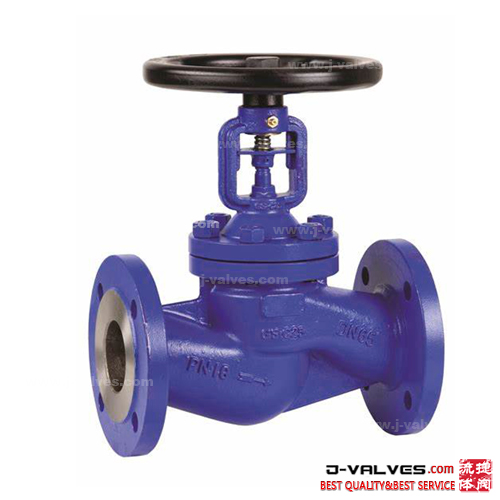
Cast Steel Material: The valve body is made of GS-C25 cast steel, which offers high strength and good corrosion resistance, suitable for various media and working conditions.
Bellow Sealing: Adopts a bellow sealing design to ensure 100% leak-free performance at the valve stem, maintaining sealing performance even under high-temperature conditions.
Dual Sealing Design: The bellow provides metal sealing to prevent leakage; in case of bellow failure, the packing can serve as a secondary seal.
Flanged Connection: Both ends adopt a flanged connection method that complies with DIN standards, ensuring convenient installation and reliable sealing.
Compact Design: With small size and light weight, it is easy to install and maintain, particularly suitable for occasions with limited space.
Multiple Operation Modes: Handwheel operation is provided, which is easy to operate and suitable for manual control. Gear, pneumatic, or electric actuators can also be optionally equipped to achieve automatic control.
Fire Safety Design: Complies with relevant fire safety standards; even in case of fire, the valve can maintain sealing performance to safeguard the safety of personnel and equipment.
Anti-Static Device: A built-in anti-static device ensures electrical continuity, prevents static accumulation, and reduces the risk of fire and explosion.
Technical Parameters
Nominal Diameter: DN65 (2 1/2 inches)
Pressure Class: PN16
Temperature Range: -29℃ to +425℃
Materials:
Valve Body: GS-C25 Cast Steel
Valve Disc: 2Cr13, 304 Stainless Steel, 316 Stainless Steel
Valve Stem: 2Cr13, 304 Stainless Steel, 316 Stainless Steel
Bellow: 304 Stainless Steel, 316 Stainless Steel
Connection Method: Flanged Connection (RF), compliant with DIN standards
Design Standard: DIN 3356
Testing Standard: EN 12266-1
Face-to-Face Dimensions: DIN 3202
Application Fields
Oil and Natural Gas Industry: Used in oil and gas field exploration, gathering, transportation, and processing systems to control the flow direction of fluids and ensure the smooth progress of the production process.
Chemical Industry: Suitable for the transportation and reaction systems of various chemical media, preventing medium leakage and ensuring production safety.
Water Treatment Industry: Applied in the water supply and drainage systems of water plants and sewage treatment plants to control the on-off and flow direction of water, improving water treatment efficiency and water quality safety.
Food and Beverage Industry: Meets food-grade requirements and is used in pipeline systems during food and beverage production to ensure hygiene and safety.
HVAC: Used in cooling water systems, hot water systems, etc., to control the on-off and flow direction of water, ensuring the efficient operation of the system.
General Industrial Applications: Suitable for the control and isolation of media such as water, oil, and gas, ensuring the safe and efficient operation of the system.
Advantages and Value
High Reliability: The GS-C25 cast steel material and bellow sealing design ensure the valve operates stably in high-pressure and high-temperature environments, reducing maintenance frequency and downtime.
High Safety: The fire protection, anti-static design, and reliable sealing performance effectively reduce the risk of leakage, safeguarding the safety of personnel and equipment.
Easy Operation: The handwheel operation mode provides a stable and labor-saving operation experience, suitable for manual control. Automatic actuators can also be optionally equipped to achieve remote control.
Convenient Installation and Maintenance: The flanged connection simplifies the installation process and also facilitates maintenance and overhaul, reducing maintenance costs.
Wide Applicability: Multiple material options and a broad range of pressure and temperature make it adaptable to various complex working conditions and medium characteristics.
Product Drawing

In industrial pipeline systems, filtration equipment plays an essential role in protecting pumps, valves, heat exchangers, and other critical components from solid particles and mechanical impurities. Among various filtration solutions, Y Strainer and Basket Strainer are two of the most widely used designs.
Follow ASME B16.34 guidance to evaluate high‑pressure angle globe valves for petrochemical refining. Learn working benefits, application limits, material selection & specification tips for severe‑service process units.
J‑VALVES 150LB CF8M swing check valves built to API 6D & ASME B16.5 standards. Prevent back‑flow for oil & gas pipelines, refineries, and process systems. Reliable flanged non‑return valve solutions.
In marine, offshore, power generation, and industrial fluid control systems, material selection plays a critical role in valve performance and service life. C95800 Nickel Aluminum Bronze Gate Valve has become a preferred solution for demanding applications due to its excellent corrosion resistance, high mechanical strength, and superior resistance to seawater erosion.
In industrial pipeline systems, a Y Type Strainer plays an important role in protecting pumps, valves, meters, and other equipment by removing solid particles from flowing media. Selecting the correct pressure class is essential to ensure safe operation, reliable filtration performance, and long service life.
DN100 PN160 CF8M gate valve manufactured per API 600 and ASME B16.34 standards. CF8M stainless steel construction delivers stable sealing performance for chemical, oil & gas high‑pressure pipeline applications.
Forged steel 3‑piece (3PC) threaded ball valves are widely used in oil, gas and high‑pressure fluid export projects. Global industrial projects adopt ASME B16.34 for valve body design and manufacturing, while API 598 governs finished‑valve pressure‑test acceptance. This article walks through the full workflow: forging incoming inspection, precision machining, assembly, hydro‑pneumatic testing and marking, explaining how these two leading standards deliver consistent structural strength, reliable sealing and worldwide spare‑part interchangeability.
The comparison of T Strainer vs Y Strainer is a common topic when engineers select pipeline filtration solutions. Although both strainers are designed to remove unwanted particles from fluids, they have different advantages in terms of flow capacity, pressure drop characteristics, and installation requirements.
Compared with conventional butterfly valves, the C95800 Triple Offset Butterfly Valve offers significant advantages in high-performance applications, especially where corrosion resistance, tight shut-off, and long-term operation are required.
ASME B16.34 compliant 26‑inch Class150 C95800 nickel‑aluminum bronze triple eccentric wafer butterfly valve. Excellent seawater corrosion resistance, metal‑to‑metal tight shut‑off for offshore platform and energy piping systems.
In industrial pipeline systems, valves play a critical role in controlling fluid flow, ensuring system safety, and maintaining stable operation. Among various industrial valve designs, the Plug Valve is widely recognized for its simple structure, excellent sealing capability, and reliable performance under demanding working conditions.
Many engineers confuse fully‑welded body and butt‑weld end connections for ball valves. Learn 3‑piece trunnion ball valve structure, pros cons and application tips to avoid project mistakes.
In industrial pipeline systems, protecting pumps, valves, meters, and other critical equipment from solid particles is essential for maintaining stable operation and reducing unexpected downtime. The Y Strainer has become one of the most commonly used filtration solutions due to its compact structure, easy installation, simple maintenance, and reliable protection performance.
DN100 PN15 UB6 pneumatic soft‑seated plug valve adopts PTFE sealing structure. Learn its sealing principle, field benefits for chemical, oil & gas pipelines, zero‑shut‑off performance and valve selection tips.
DN400 PN160 A105 extended stem fully welded trunnion ball valve complies with ASME B16.34 pressure‑temperature rating & API 6D pipeline valve specification. Learn how two authoritative standards govern body material, wall thickness, testing & buried‑pipeline performance for gas transmission & high‑pressure heating projects.
In industrial pipeline systems, valves play a critical role in controlling fluid flow, ensuring system safety, and maintaining operational efficiency. Among various valve types, the Globe Valve is widely used for applications requiring precise flow regulation, reliable shut-off performance, and stable operation.
In industrial pipeline systems, protecting pumps, valves, flow meters, and other critical equipment from solid particles is essential for maintaining stable operation. The Y Strainer is one of the most widely used filtration devices due to its compact design, efficient filtration performance, and easy maintenance.
24‑inch Class 600 WC6 swing check valve engineered for high‑temp high‑pressure piping. Explore WC6 material benefits, swing‑type structure, suitable for power plant, petrochemical and oil‑gas projects. J‑VALVES industrial valve solution since 2009.
In modern industrial piping systems, valves are required to provide reliable shut-off performance, low operating torque, and long service life under demanding operating conditions. Compared with traditional concentric butterfly valves, the Double Offset Butterfly Valve offers improved sealing performance, reduced friction, and enhanced durability, making it an ideal choice for water treatment, power generation, oil & gas, chemical, and industrial applications.
The C95800 Y Strainer, manufactured from ASTM B148 C95800 Nickel Aluminum Bronze, provides an advanced filtration solution for demanding marine and industrial applications. With excellent seawater corrosion resistance, superior erosion resistance, and outstanding mechanical strength, Nickel Aluminum Bronze Strainers are widely used in offshore platforms, shipbuilding, power plants, and seawater cooling systems.