| Availability: | |
|---|---|
| Quantity: | |
2“-56”
J-VALVES
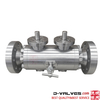
The Double Block And Bleed Valve is used to cut off or connect the media in various of Class150~Class2500. The valves made of different materials are suitable for various media such as water, steam, oil, liquefied gas, natural gas, coal gas, nitric acid, oxidizer, urea and etc. The driving modes include manual operation and electric operation. The connection ends can be flange or butt welding.
Double block and bleed valves are most commonly used in the oil and gas industry, but can also be helpful in many other industries. It’s typically used where bleeding the valve cavity is required, where piping needs isolation for maintenance, or for any of these other scenarios:
1. Double Block And Bleed Valve Technical specifications:
l 3-Piece Bolted Body, Full Port Construction
l Fully Compliant to ASME B16.34
l Fully Compliant to API 6D
l API 607 6th Edition Fire-Safe
l Submerged Packing System & Direct Mount Actuation
l Second Generation PTFE Seats Provide Higher Operating Temperatures
l Standard Electrically Grounded Ball & Stem
2. Double Block And Bleed Valve Product Specification:
l Size: 2''-56''(DN50~DN1400)
l Pressure Rating: 150LB-900LB/PN16~PN100/10K~60K)
l Material: A351 CF8M/CF8/CF3/CF3M, A216 WCB, A352 LCB/LCC,F51/F53/C95800
l Suitable Temperature: -196ºC~450ºC( Different temperature choose different materials).
l Suitable Medium: Water, Steam, Oil and natural gas etc.
3. Double Block And Bleed Valve Product Feature:
l Fixed ball, full bore or reduce bore.
l Mounting trunnion Ball valve
l Blow-out proof stem design.
l PTFE/RPTFE seat seal( Seat seal material could be decided by customer's request or according to valve's medium & temp. condition).
l Anti-static design and API 607 Fire Safe Design available
l Operation: Hand wheel, Worm wheel,Gear, Pneumatic actuator & Electric Actuator.
Note: All the data should be confirmed with the approved drawings of manufacturer.
Tips:
We also manufacture other type valves, as butterfly valve, check valve, globe valve, Y strainer, sanitary butterfly valve, sanitary ball and so on.
Any item meets your interest, anything confused you, pls keep me posted, let's talk more.
J-VALVES Service:
l On Samples Buyer bear the air fee, but this fee will be reduced from order directly
l On After Sales Free replacement if there is any quality problem
l On Delivery Never delay delivery time
l On Materials Ensure material pure
l Ensure material pure
API 598 test durations by size, why the timer starts after the pressure settles, and what a 1.5 times shell test cannot tell you about service.
Pneumatic actuator failure modes and field diagnostics: air supply quality, diaphragm rupture, spring relaxation, torque margins and partial stroke testing.
How a butterfly valve disc is fixed to its stem: taper pins, pinless hubs and through shafts, the backlash each allows, and the failures they cause.
Steam PRV station design: critical pressure ratio, Kv sizing, 1/3-2/3 parallel turndown, series stations and safety valve sizing rules.
Why LNG ball valve seats that pass warm tests leak cold at -162°C: contraction arithmetic, cold preload, PCTFE vs PTFE, ISO 28921-2 and MSS SP-134 limits.
What API 607 proves: burn sequence, 7th-edition leak limits per NPS, cavity pressure rules, API 6FA vs ISO 10497, and the clauses buyers must check.
MSS SP-80 bronze valves: the class number is a saturated steam rating, not a pressure rating. Alloys, threads, lead-free rules and where bronze stops.
Stellite or tungsten carbide for erosive service: erosion angles, hardness ratios, HVOF vs weld overlay, the 500 C limit, and the clauses that win acceptance.
Valve coating is a defect-budget decision, not a product choice: ENP vs FBE vs sprayed aluminium, holiday arithmetic, CUI and the specs that win acceptance.
Temporary and start-up strainers for commissioning: placement, plate versus mesh, blowdown discipline and the removal record that proves it was pulled.
What MSS SP-25 marking really commits to: body symbols, three-symbol trim marking, melt identification and the certificate that closes the loop.
Why ball valves pass high-pressure seat tests and fail at 0.6 MPa: seat preload arithmetic, SPE and DPE seats, DBB vs DIB-1/DIB-2, and test-proofing specs.
RF, RTJ and butt-weld valve ends compared: how each joint seals, which duty suits it, and the four assembly errors that cause most joint leaks.
Why PTFE and PFA liners fail when the chemistry is right: permeation arithmetic, vacuum collapse, cold flow and the 11:1 expansion mismatch at the flange.
C95800 and C95500 are cast to ASTM B148; C63200 is wrought to ASTM B150. Aluminum and manganese levels decide strength, weldability and valve use.
Jacket heat load arithmetic, sulfur's 159 C viscosity trap, the separate jacket pressure test and the weld failures buyers discover in year five.
API 603 and API 600 both cover bolted bonnet gate valves, but wall thickness basis, class ceiling and casting rules decide which one you can actually buy.
ISO 5208 Rates A-G explained with real numbers, how API 598, API 6D and FCI 70-2 map across, and what metal seats can honestly achieve.
How to choose a forged or cast valve body: API 600 vs API 602 size limits, casting quality factor, NDT coverage, weld repair policy and cost crossovers.
How pressure seal bonnet valves work, why bolted bonnets stop at Class 900, seal ring materials, disassembly rules and the low-pressure leak signature.