Views: 0 Author: J-VALVES Publish Time: 2026-09-30 Origin: Site


Valve shipping has a structural problem: the moment cargo leaves the factory, buyer and seller are looking at the same crate through completely different information windows. What tests were run, how the valve was secured, whether the wood was treated — at destination, all of that can only be inferred.
We started documenting packing systematically after a Middle East order in 2023. The buyer reported a handwheel position shift on arrival and suspected impact damage in transit. All we could produce was a paper packing list and test reports — no photos of the in-crate securing. We ended up negotiating a replacement accessory shipment.
Since then, every critical node in the packing process gets a timestamped record. From a procurement standpoint the logic is simple: one dated photo beats ten sentences of "our packing is very good."
Per API 598 and GB/T 12237, shell hydrostatic pressure is 1.5× nominal. For this Class 600 batch the test pressure was 15.0 MPa held for 10 minutes.
The detail that matters: the ball must sit at half-open and the cavity filled with water with all air bled off first. Trapped air produces pressure fluctuation during the hold, which gets misread as leakage. Photo Set 1 shows the gauge at 15.0 MPa with the rig timer logging hold duration.
Pass criteria: no visible leakage at shell, stuffing box or body joints, and no pressure drop during the hold.
After hydro testing we run compressed air at 0.6 MPa. This catches leak paths that water testing tends to mask, particularly around the stem packing.
The valve goes into a water bath and gets observed for one minute — no continuous bubbles means pass. Pressure is ramped in stages rather than all at once, because a sudden full-pressure hit deforms the packing under compression and tends to cause leaks later in service.
Seat tests run on each end separately at 1.1× nominal pressure, with hold time stepped by nominal bore. DN300 corresponds to 120 seconds.
This is where our batch had its one problem. Unit No. 7 showed a minor seat leak on the first re-test — roughly 6 drops per minute, above the zero-leakage requirement API 598 sets for soft-seated valves. Teardown revealed a light score mark on the seat insert from assembly.
What we did: replaced the seat insert, re-lapped the mating face, re-ran the seat test at the same pressure. Re-test showed zero leakage, and the valve was released. Those photos are in the gallery too — the No. 7 shot shows the replacement insert in place.
This is not self-flagellation. A documented rework is the most direct evidence a buyer has that a supplier is actually inspecting. A record claiming "zero defects across the entire batch" is, to an experienced procurement engineer, the suspicious kind.
After testing, residual water in the cavity has to be fully drained and blown dry. Skip this and you get internal wall corrosion in a high-humidity sea freight environment. That is not a cosmetic issue — corrosion contaminates the downstream medium.
Photo Set 2 shows us alternating dry compressed air from both ends, then confirming with a borescope that no standing water remains. External coating dry film thickness was spot-checked at 180–220 μm, within the customer specification.
This is the core of moisture protection for sea freight, and the step most often cut short.
Our approach works in three layers:
VCI vapour-phase film lining the valve cavity. The corrosion-inhibiting vapour forms a protective layer in the enclosed space. For a cavity with moving surfaces, this beats straight anti-rust oil, which fails once the film dries out.
Full-unit VCI stretch wrap covering the flange faces and exposed stem, with plastic caps on the flange sealing faces.
Desiccant at 30 g/m³ of crate volume. This batch: roughly 2.4 m³ per crate, so 75 g of desiccant split into two sachets hung on either side of the upper crate section, plus a humidity indicator card for fast verification at unboxing.
The 30 g/m³ figure is not a rule of thumb. Container interiors swing in temperature day to night during a sea passage, and airborne moisture condenses on metal surfaces. That loading rate is derived from unit-volume saturation moisture content with conservative redundancy for a 45-day voyage. Ship with one or two sachets and anything beyond a 30-day route starts carrying real risk.
A DN300 trunnion mounted ball valve at 1,860 kg needs a defined lifting plan. Lift from the body lugs or the body itself. Never from the handwheel, gearbox or actuator.
The reason is mechanical: handwheel and gearbox connections are designed for operating torque, not for full assembly weight. Lift from them and you get deformation at best, detachment at worst. Photo Set 3 shows slings through the body lugs with a four-point balanced rig controlling attitude, so the ball cannot shift relative to the seat under tilt during the lift.
Corner protectors go where slings contact the body. Coating damage is where corrosion starts in a humid cargo hold.
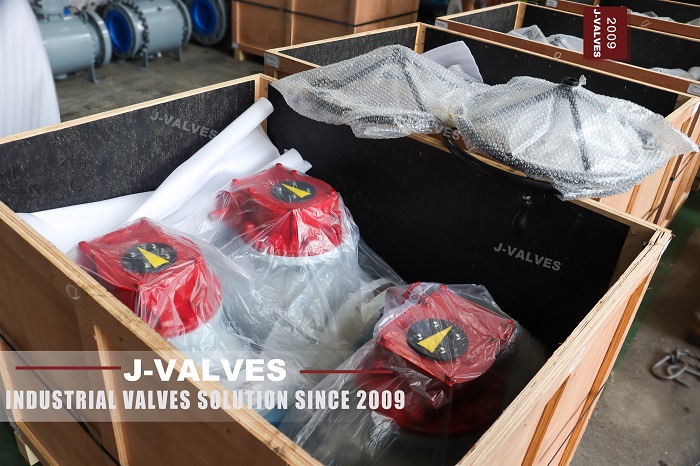
In-crate securing determines whether the valve moves in transit. Our method:
Hard rubber pad under the body to spread concentrated load;
Custom timber battens wedged on both sides with soft pads between batten and body — no hard contact;
Flange faces oriented toward the access opening in the crate wall, so the port authority or the buyer can inspect without full unpacking;
A packing list copy inside, with the shipping documents in a sealed bag fixed to the inside of the lid.
The photo of the finished securing arrangement is the single most valuable frame in the whole record. It simultaneously documents the packaging method and the valve's external condition at the time of crating.
Common procurement misconception: not all wooden crates require fumigation.
Under ISPM 15, solid wood packaging must be heat-treated or fumigated and carry the IPPC stamp. Plywood, fibreboard and other engineered wood panels are processed under heat and pressure during manufacture, so they are not regulated wood packaging and are exempt from fumigation — a packaging declaration is all that is required.
This batch used fumigation-exempt plywood, so there is no IPPC fumigation stamp on the crate. What is marked on the outside: product name and specification, quantity, gross and net weight, lifting centre line, moisture and this-way-up symbols, destination port and contract number.
We chose the exempt route for lead time. Solid wood crates add typically 2–3 working days for the fumigation cycle. On a tight delivery, plywood saves that time and removes the risk of a port-of-destination hold over a marking issue.
This customer appointed a TPI agency to witness packing. A TPI packing inspection generally covers:
Item | This batch |
Serial numbers vs. packing list | 12 units checked individually — consistent |
Shell and seat test reports | Provided, including the No. 7 rework and re-test |
Body marking and nameplate | Material, pressure class and heat number traceable |
In-crate securing and moisture measures | VCI and desiccant loading witnessed on site |
Shipping document completeness | All five categories present — see below |
The failure mode in TPI witnessing is rarely the product itself. It is documents not matching hardware — a nameplate heat number that conflicts with the MTC, or a packing list one unit off from physical count. Caught at destination, that costs far more than a pre-shipment check.
Organise the export documents into five categories. Missing any one tends to stall customs clearance or receiving:
Packing list — crate number, description, specification, quantity, net weight, gross weight, crate dimensions
Pressure test report — dates, pressures and pass/fail conclusions for shell, air and seat tests
Material test certificate (MTC) — body and ball material, heat numbers, mechanical properties
Certificate of conformity — serial number mapping, inspector signature, date of manufacture
Packaging declaration — stating the crate is engineered wood and fumigation-exempt, for destination quarantine verification
Offshore project orders usually require a coating inspection report and NDT reports on top of these. Confirm against the customer's technical specification.
A table of real objections is more useful than a lecture on packaging theory:
Objection | Root cause | Resolution |
Surface rust spots after unboxing | Insufficient desiccant or breached crate seal | On-site derusting and touch-up; carrier liability goes to insurance |
Handwheel or gearbox position shifted | Actuator not separately secured in crate | Added independent actuator support to the standard plan |
Flange sealing face scratched | No cap fitted, or cap detached in transit | Switched to fixed caps and added them to the packing photo record |
Nameplate heat number mismatched with MTC | Wrong nameplate fitted on the shop floor | Added a two-person verification gate before shipment |
Desiccant sachet torn | Suspension method over-stressed the bag | Moved to fixed hooks on both crate sides |
The value of this table is upstream: buyers can write these terms into the technical agreement before signing — specify a desiccant loading minimum, require packing photo records, require independent actuator support. Raise it at receiving and your negotiating room is already gone.
What tests are required before a trunnion ball valve is packed?
Shell hydrostatic at 1.5× nominal, seat leakage at 1.1× nominal, plus a 0.6 MPa low-pressure air test. Pass criteria per API 598 and GB/T 12237.
Is fumigation always required for wooden crates?
No. Solid wood packaging requires ISPM 15 heat treatment or fumigation with the IPPC stamp. Plywood and engineered wood panels are exempt — a packaging declaration suffices.
What moisture protection works for sea freight?
VCI film lining the cavity, full-unit VCI stretch wrap, desiccant at 30 g/m³, and a humidity indicator card. This configuration is normally adequate for voyages up to 45 days.
How do you lift a large diameter trunnion ball valve?
From the body lugs with a four-point balanced sling rig. Never from the handwheel, gearbox or actuator. Use corner protectors at sling contact points.
What do TPIs check during packing?
Five items: serial number consistency, test reports, nameplate and material traceability, in-crate securing and moisture measures, and document completeness.
What if the crate arrives damaged?
Photograph the crate and its contents first, verify valve exterior, flange sealing faces and in-crate securing, then file in writing within the contractual objection window (commonly 24–48 hours). Do not unload before you have documented.
Packing a trunnion ball valve is less a packaging engineering problem than a documentation problem. Whether the tests were run, the moisture protection applied, the securing done — if photos and data can settle it, do not leave it to be argued at the receiving end.